400 ml divided by 1000 gives 0.4 liters. The formula is clear, but conversion errors persist in kitchens as well as in professional environments. The factor of 1000 that connects milliliters and liters poses no problem on paper. Difficulties arise when handling graduated containers, adapting an Anglo-Saxon recipe, or needing to convert on the fly between centiliters, deciliters, and liters.
Discrepancies Between Theoretical Volume and Measured Volume in Practice
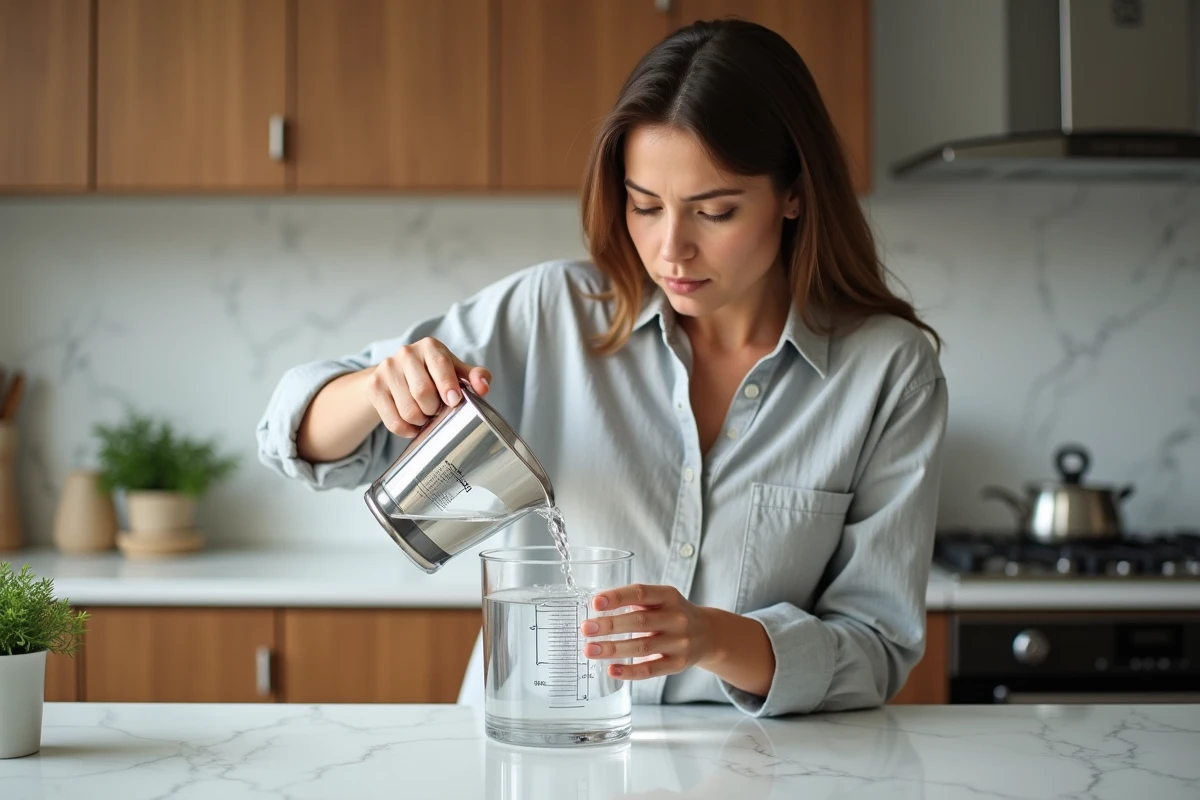
When we pour 400 ml into a kitchen measuring cup, the displayed result is not always reliable. The surface tension of the liquid, ambient temperature, and the quality of the graduation of the container introduce measurable discrepancies. In metrology, these variations are documented by ISO standards 4788 (laboratory glassware) and ISO 1042 (graduated flasks).
A plastic measuring cup sold in a supermarket does not offer the same precision as a laboratory graduated cylinder. For a cooking recipe, the discrepancy remains negligible. For pharmaceutical or cosmetic dosing, it changes the game.
To convert 400 ml to liters without error, we recommend always reading the graduation at eye level, placing your gaze at the level of the meniscus (the curve formed by the liquid at the surface). Reading from above or below skews the measurement by a few milliliters, which affects the result in liters.
Conversion Method from ml to Liter: Moving the Decimal
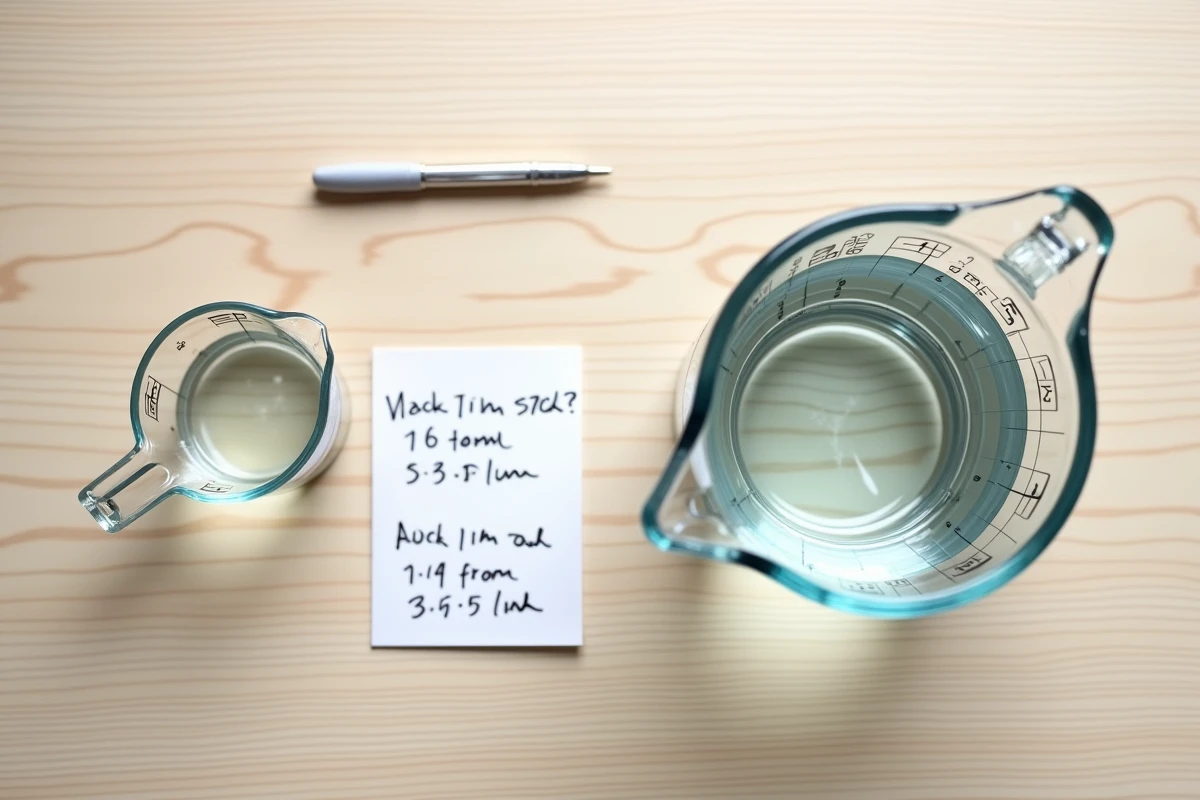
Dividing by 1000 is equivalent to moving the decimal point three places to the left. This is the only operation required, regardless of the starting volume.
- 400 ml: the decimal moves from 400.0 to 0.400, which is 0.4 L
- 750 ml: 750.0 becomes 0.750, which is 0.75 L
- 1250 ml: 1250.0 becomes 1.250, which is 1.25 L
This technique avoids the need for a calculator. It also works in the other direction: converting liters to milliliters means moving the decimal point three places to the right (0.4 L gives 400 ml).
Using Centiliters for Verification
In French cooking, centiliters appear more often than liters on packaging. Converting first to centiliters offers an intermediate checkpoint. 400 ml corresponds to 40 cl, and 40 cl to 0.4 L. If either of the two calculations doesn’t match, the error is immediately noticeable.
This double-check takes a few seconds and avoids frequent confusion between centiliters and deciliters, which can trap even professionals in the restaurant industry.
Conversion Table for Milliliters, Centiliters, Liters
| Milliliters (ml) | Centiliters (cl) | Deciliters (dl) | Liters (L) |
|---|---|---|---|
| 100 | 10 | 1 | 0.1 |
| 250 | 25 | 2.5 | 0.25 |
| 400 | 40 | 4 | 0.4 |
| 500 | 50 | 5 | 0.5 |
| 750 | 75 | 7.5 | 0.75 |
| 1000 | 100 | 10 | 1 |
This table covers the most common volumes in cooking and home dosing. The conversion factor remains the same regardless of the liquid: water, milk, oil, or syrup. The volume does not change with the density of the product (the mass, however, varies).

Common Conversion Errors and Their Causes
The most widespread confusion is dividing by 100 instead of 1000. The result (4 L instead of 0.4 L) seems absurd for 400 ml, but when converting smaller volumes (50 ml, 75 ml), the error goes unnoticed and skews a recipe.
The Trap of Anglo-Saxon Recipes
Recipes from the United States or the United Kingdom express volumes in fluid ounces (fl oz), cups, or pints. An American pint is not equivalent to a British pint: the former is about 473 ml, while the latter is about 568 ml. Directly converting fluid ounces to liters without going through milliliters multiplies the risk of error.
We recommend always converting the foreign measurement to milliliters first, then applying the division by 1000 to obtain the volume in liters. This intermediate step secures the calculation.
Confusing Volume and Mass
400 ml of water weighs about 400 g at room temperature, which fosters the idea that milliliters and grams are interchangeable. This is only true for pure water. 400 ml of olive oil weighs less, while 400 ml of honey weighs more. The liter measures a volume, never a mass.
- Water: 400 ml corresponds to about 400 g
- Oil: 400 ml weighs less than 400 g (density less than 1)
- Honey: 400 ml weighs more than 400 g (density greater than 1)
On a kitchen scale, this distinction changes the final result of a recipe. When a recipe states 0.4 L of honey, converting it to grams without considering the density produces an incorrect dosage.
Conversion in Professional Context: Pharmacy, Cosmetics, Catering
Research results almost always focus on home cooking. The conversion from 400 ml to liters also occurs in pharmacies (magistral preparations), cosmetic laboratories (formulation of products), and collective catering (scaling recipes).
In these environments, the tolerance for error on volume is much lower. A discrepancy of a few milliliters on a pharmaceutical active ingredient alters the concentration of the finished product. The glassware used must meet metrology standards, and the conversion is systematically carried out with two independent verifications.
In collective catering, multiplying a recipe by ten or twenty amplifies any initial conversion error. Confusing 0.4 L and 4 L based on 400 ml results, for fifty servings, in a discrepancy of several tens of liters on the total volume.
The conversion of 400 ml to liters has only one requirement: divide by 1000, or move the decimal point three positions. The result is always 0.4 L. The real difficulty lies upstream (reliability of the graduated container) and downstream (distinction between volume and mass, adaptation of foreign units). Mastering these two points eliminates almost all dosage errors.