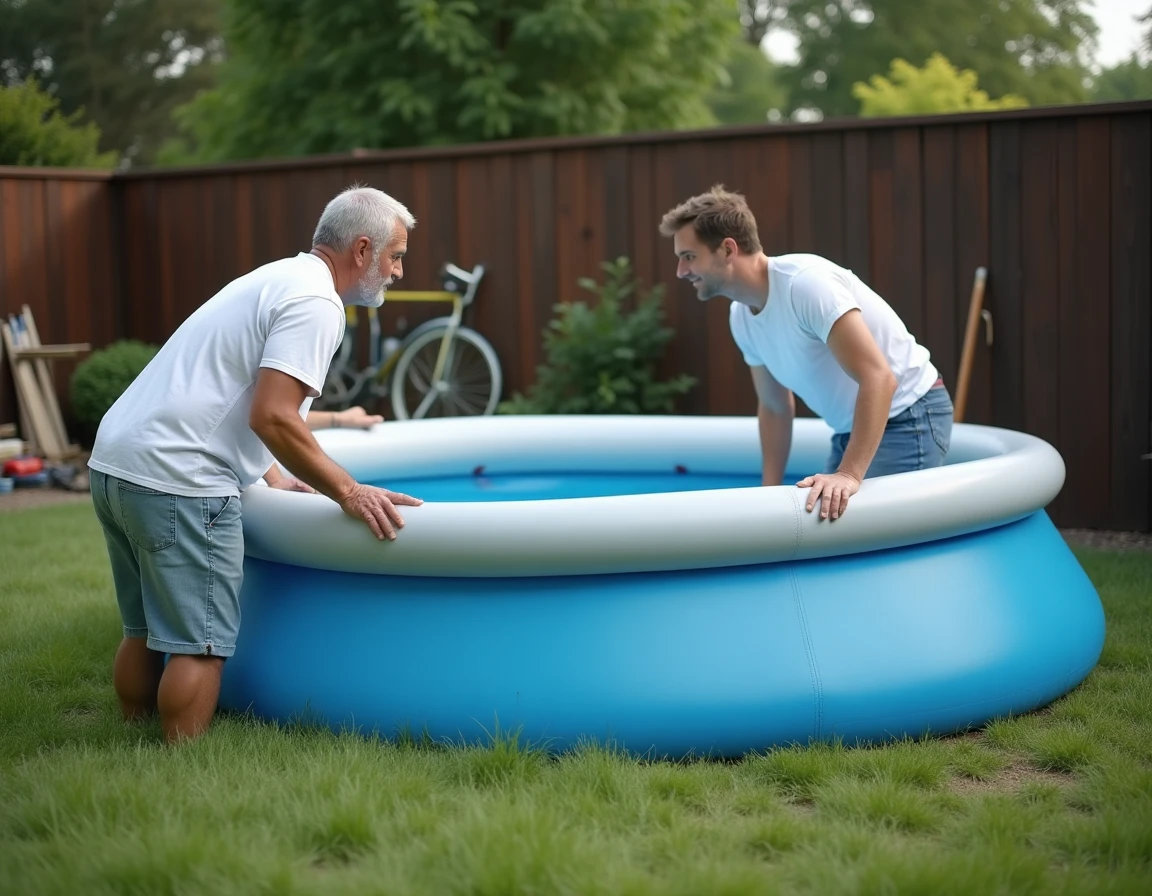
An inflatable pool that tilts a few centimeters to one side is not just a visual inconvenience. The water pressure is then distributed asymmetrically on the inflatable ring or structure, which accelerates the deformation of the liner and can cause a sudden collapse of the wall on the overloaded side.
Since 2022, Intex and Bestway have updated their warranty conditions to specify that installation on a not perfectly horizontal ground voids the warranty in case of rupture or deformation.
Late settling on grass: the problem not mentioned in the manual
Most installation guides focus on the initial preparation of the ground. They overlook a well-documented phenomenon on specialized forums since 2020: late differential settling.
Specifically, a pool placed on a lawn that seemed level can start to tilt after several weeks of use. The weight of the water gradually compresses the soil, and the backfilled or recently turned areas settle faster than the rest. This settling worsens after heavy rains when the waterlogged soil loses its load-bearing capacity.
Field reports vary on the severity of the phenomenon depending on the type of soil. On compact clay, the movement remains limited. On recent backfill or loose topsoil, a gradual tilt of several centimeters within a few weeks is not unusual. This is why it is not enough to check the level at the time of filling: regular monitoring during the first weeks of use allows for detecting the problem before it becomes critical.
For those looking to straighten a tilting inflatable pool, the first step is to identify whether the tilt is due to an initial leveling defect or this differential settling, as the solution differs in each case.
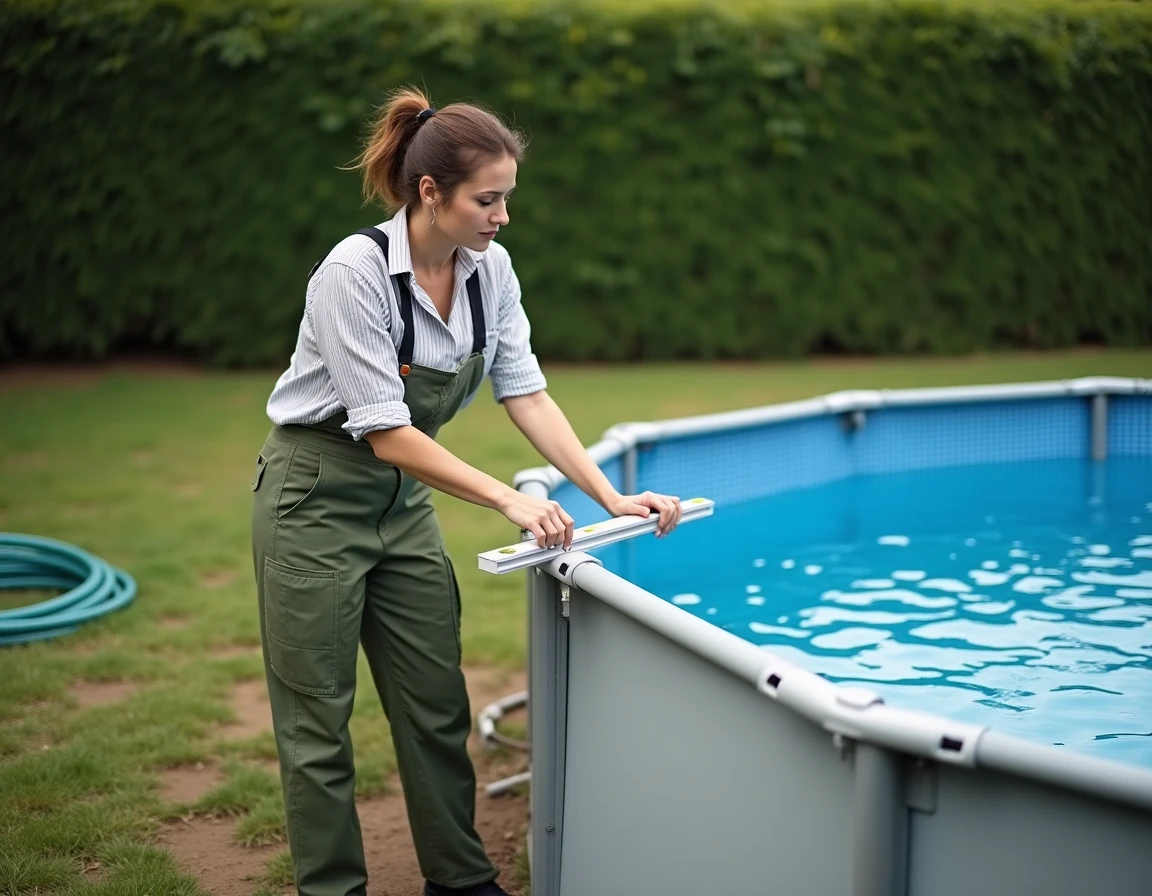
Preparing the ground before filling: sand, slabs, and bubble level
Emptying the pool remains the most reliable solution when the tilt exceeds a few centimeters. Before repositioning it, the ground must be properly treated.
Leveling and compacting the soil
Excavate the area to a sufficient depth to remove the layer of topsoil, which is too loose to support the weight of the pool over time. The cleared surface should be compacted with a roller or vibrating plate if available, then covered with a layer of sand.
- Spread the sand in a uniform layer and level it with a mason’s rule placed on two height markers at the ends.
- Check the horizontal alignment with a bubble level in at least four directions (the two diagonals and the two axes). Even a slight discrepancy results in several centimeters of difference in water height once the pool is filled.
- Compact the sand after leveling by lightly watering it, then compacting it again. Sand that is simply spread will settle unevenly under load.
Distribution slabs under the feet
Recent installation manuals (2021-2024) for tubular models now recommend using stabilizing slabs or distribution plates under each foot, especially on loose soils. These slabs increase the support surface and limit localized sinking into the lawn or soil. For an inflatable pool without feet, a rigid plate under the entire base serves the same purpose.
Can the tilt be corrected without draining the pool?
The question arises on all forums: draining several thousand liters of water to reposition an inflatable pool seems disproportionate. Several “hot” correction methods circulate, but their limits are rarely specified.
Sliding wedges (boards, slabs) under the low side of the pool is the most cited technique. It can work for a very slight gap, on the order of one or two centimeters. Beyond that, the wedge creates a localized stress point under the liner, which risks puncturing or deforming. Wedge a filled pool does not correct an unstable ground, but temporarily masks the symptom.
Some users attempt to lift one side of the ring to reposition the base. On a small model (less than two meters in diameter), it is feasible with two people with caution. On a family-sized pool, the weight of the water makes the operation dangerous: a sudden movement can bend the structure or cause a violent overflow.
However, a partial drain (removing about a third of the water) sufficiently lightens the pool to reposition it without fully draining it. This is a reasonable compromise when the underlying ground requires only a minor adjustment.
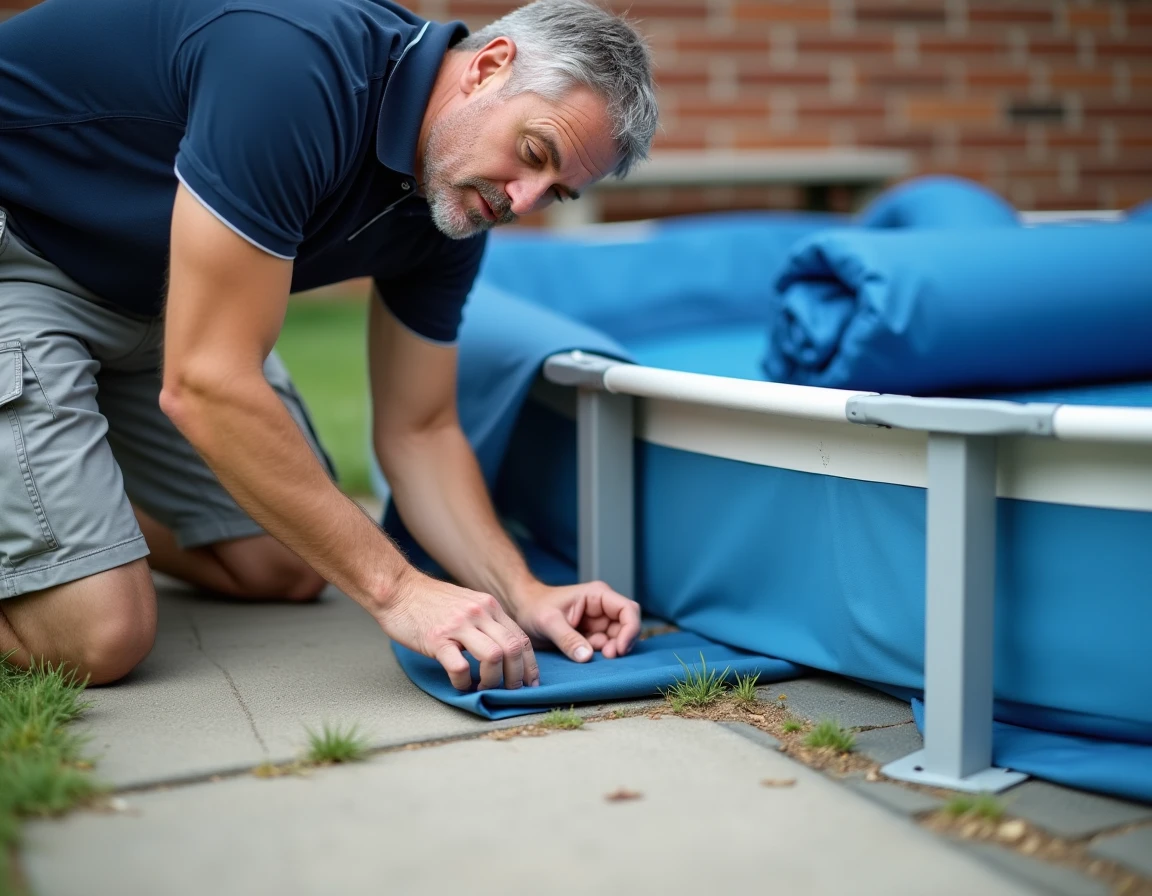
Loose soil, roots, and natural slope: diagnosing the real cause
Before correcting anything, identifying what causes the tilt prevents repeating the same mistake during repositioning.
- A naturally sloped ground (even slightly) can be detected with a bubble level or a clear water hose placed on the ground. Correction involves excavating the high side, never backfilling the low side, which will inevitably settle.
- Nearby tree roots create bumps under the liner and destabilize the base. If trees are within a few meters, consider moving the pool rather than cutting the roots, which will regrow.
- A freshly backfilled area or recently laid lawn has not had time to stabilize. Uncompacted backfill can settle unpredictably throughout the first season.
The choice between on-site correction and relocation depends on the diagnosis. A naturally sloped ground is corrected by grading. A ground that settles after a few weeks of use requires base reinforcement, not just simple leveling.
The majority of problems with a tilting inflatable pool originate from the preparation of the ground, rarely from a defect in the pool itself. Taking the time to level, compact, and check the horizontal alignment with a reliable tool before the first filling remains the only method that avoids having to redo the operation every summer.