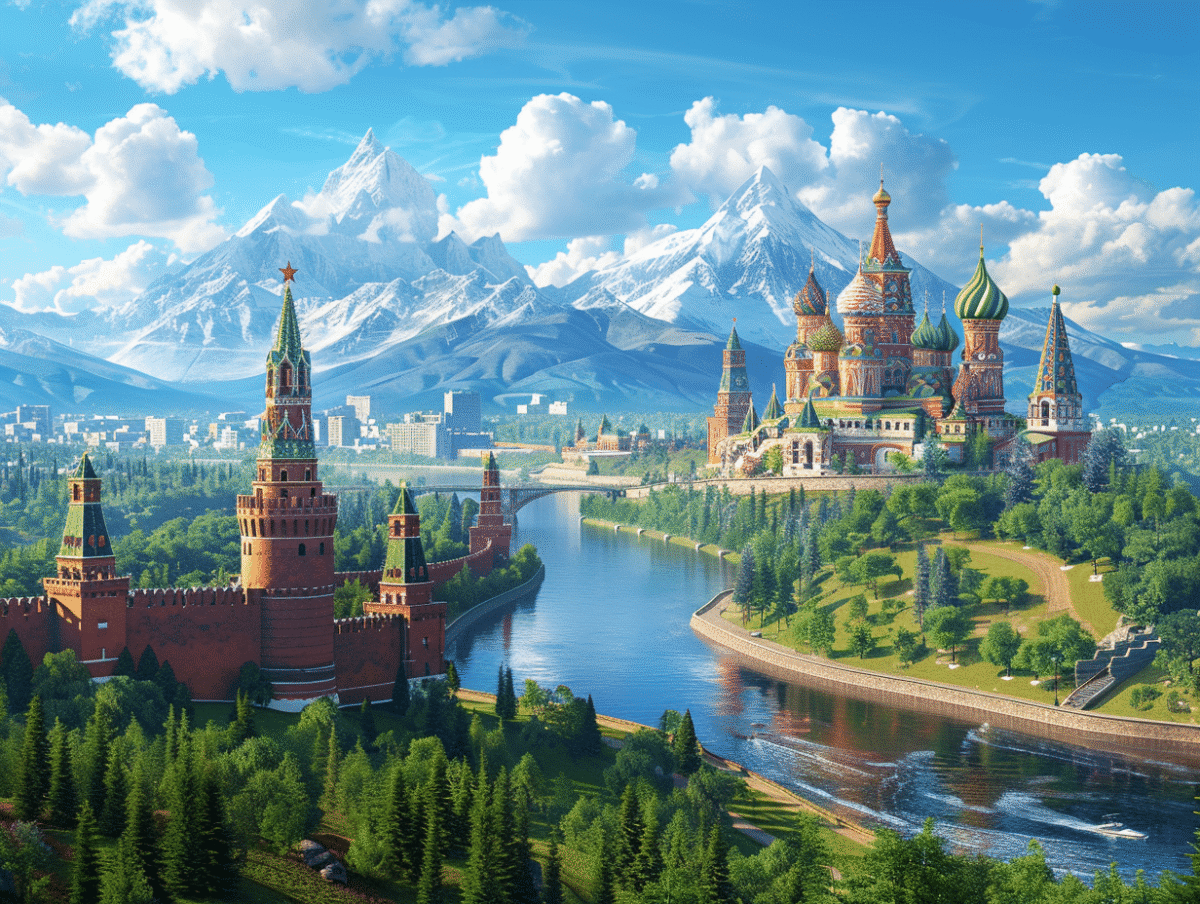
The world is a fascinating patchwork of nations, each with its own characteristics that make it unique. When we look at the giants of the globe, we cannot help but feel impressed by the vastness of their area. These terrestrial colossi stand out not only for their size but also for the diversity of their landscapes, climates, and ecosystems. Russia, Canada, China, the United States, and Brazil dominate the maps with their vast territories. Exploring the largest countries in the world means discovering varied cultures, rich histories, and exceptional natural phenomena, from frozen tundras to lush tropical forests.
The giants of the globe: discovering the largest countries by area
When we question What is the largest country in the world, the answer is hardly suspenseful: Russia, with its 17 million square kilometers, reigns supreme on the podium of national areas. Following are Canada, China, the United States, and Brazil, each exceeding 7 million square kilometers. These immense territories play a crucial role in the regulation of renewable freshwater natural resources, shared by what are called the ‘9 water giants’, which together concentrate 60% of these precious resources. The area of France, while considerable on a European scale, pales in comparison to these giants of the Earth.
At the heart of these colossal expanses, water, which covers 72% of the Earth’s surface, is estimated to have a total volume of 1,400 million km3. Of this volume, 97.5% is made up of saltwater, leaving a minimal portion of 2.5% representing all freshwater. The latter, vital for the survival of ecosystems and human societies, includes permanent ice and snow (2.1%) and an infinitesimal fraction available for consumption (0.7%). Countries with large areas are therefore key players in the management and preservation of freshwater, an essential natural resource.
The management of this water, inscribed in the eternal water cycle characterized by stages such as evaporation, condensation, and precipitation, is a major issue of sustainable development. These stages are reflected both on a planetary scale and in domestic cycles of collection, treatment, storage, distribution, and decontamination. The availability of freshwater by basin, as well as its quality, can vary significantly, a reality confirmed by projections from 1995 to 2025, highlighting the ongoing challenge of water management in the Anthropocene era.
Particularities and diversities: the unique characteristics of vast territories
Beyond the figures that outline the mapping of their vastness, the largest countries in the world are distinguished by unique characteristics that shape their identity. Water, in particular, occupies a central place with its multiple faces: it covers 72% of the Earth’s surface and is distributed in a total estimated volume of 1,400 million cubic kilometers. But this abundance hides a disparity: 97.5% of this water is salty, relegating freshwater, so fundamental to our societies, to a meager portion of only 2.5%.
This relative scarcity of freshwater is accentuated when considering its distribution. Permanent ice and snow capture 2.1% of this freshwater, leaving an even smaller portion, just 0.7%, directly accessible for human use. These figures highlight the fragility of our water resources and the necessity for meticulous and foresighted management, in line with the principles of sustainable development.
The analysis of water cycles contributes to understanding these dynamics. The natural cycle, with its stages of evaporation and evapotranspiration, condensation, precipitation, infiltration, runoff, stagnation, and return to the sea, illustrates the perpetual transformation and movement of water. At the same time, the domestic water cycle of collection, treatment, storage, distribution, and decontamination reveals the extent of human interventions aimed at domesticating this resource for our needs.
In the face of these complexities, water management proves to be an essential issue for the future. Consider the variations in the availability of freshwater by basin, particularly the projections from 1995 to 2025, which indicate notable fluctuations. This data underscores the imperative to adapt our management strategies to the changing realities of water availability, to ensure the sustainability of ecosystems and the water security of populations.